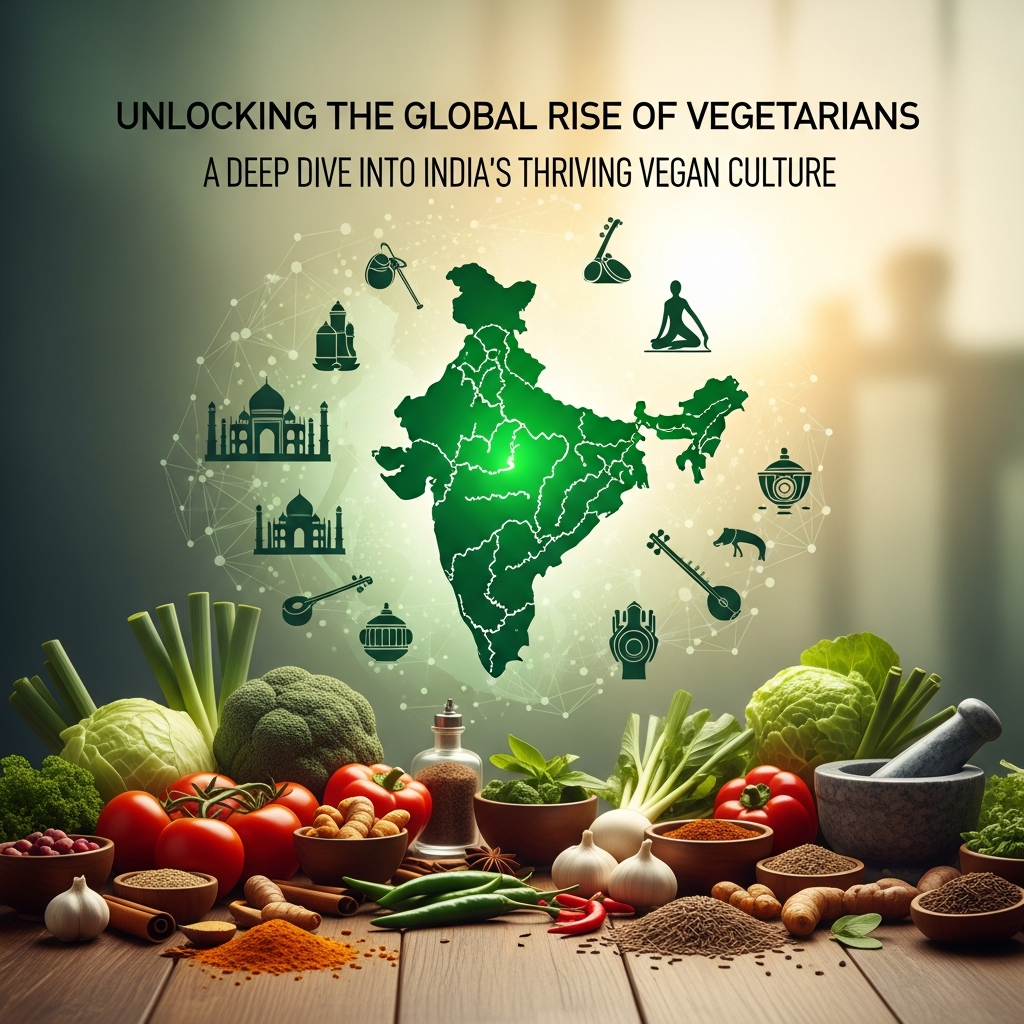
For many, vegetarianism or veganism is the final frontier of compassionate eating. But what if there was a culinary philosophy that took this principle even further, extending its consideration to the smallest of life forms, including microbes and the very soil beneath our feet? Welcome to the world of Jain cuisine, an ancient dietary practice rooted in the profound principle of Ahimsa, or non-violence. More than just a set of rules, it is a deeply conscious and scientific approach to food that offers fascinating insights for anyone passionate about mindful, plant-based eating.
The Core Principle: Ahimsa and the Hierarchy of Senses
The entire foundation of Jain cuisine rests upon Ahimsa, the ethical principle of causing no harm to any living being. This concept is applied with meticulous detail, guided by the Jain understanding of the hierarchy of life. According to Jain philosophy, all living beings are categorized based on the number of senses they possess, from one to five. At the bottom are one-sensed beings (ekendriya), which include plants, water, air, fire, and earth. At the top are five-sensed beings (panchendriya), which include humans and most animals.
The goal of a Jain practitioner is to minimize harm to all life, but since survival necessitates consumption, the diet is designed to impact only the one-sensed beings (plants) and to do so in the least violent way possible. This is why all animal products, including meat, poultry, fish, and eggs, are strictly forbidden. The philosophy dictates that causing harm to a being with more senses, and thus a greater capacity to feel pain and experience life, incurs a greater negative karmic impact.
This framework explains why Jainism is strictly vegetarian, but it also serves as the launching point for its more unique and specific restrictions. The commitment is not just to avoid killing animals, but to actively choose foods whose cultivation, harvesting, and preparation result in the absolute minimum amount of harm to the entire web of life, from the plant itself to the microorganisms it supports.
Beyond the Surface: The Prohibition of Root Vegetables
One of the most distinctive features of Jain cuisine is the complete avoidance of root vegetables. This means no potatoes, onions, garlic, carrots, beets, or radishes. To an outsider, this might seem arbitrary, but it stems directly from the core principle of Ahimsa. When you harvest a fruit, a leaf, or a bean, the parent plant often continues to live and produce. However, when you pull a root vegetable from the ground, you are uprooting and killing the entire plant, ending its life cycle. This is considered a more significant act of violence than plucking a part of a plant that can regenerate.
The "science" behind this practice, however, goes even deeper, into the realm of microbiology and ecology. Jain texts describe a vast community of microscopic life forms, known as nigodas, that exist everywhere but are particularly concentrated in the soil and around roots. Uprooting a single potato or onion inevitably destroys this entire complex and thriving underground ecosystem. By avoiding root vegetables, practitioners are not only sparing the life of the plant but are also consciously protecting the countless microorganisms that depend on that root system for survival.
This perspective predates modern microbiology by centuries, yet it aligns remarkably with our current understanding of soil biomes. The rhizosphere—the area of soil directly around a plant's roots—is one of the most densely populated microbial habitats on Earth. The Jain prohibition, therefore, can be seen as an ancient form of ecological preservation, aimed at minimizing disruption to the delicate, unseen life that sustains the soil.
A Microscopic View: Rules on Fermentation and Freshness
The Jain commitment to non-violence extends all the way to the microbial world. This leads to careful restrictions on foods that are products of fermentation or that encourage the growth of bacteria and yeast. For this reason, many traditional Jain households avoid mushrooms and other fungi, as they are considered parasitic life forms that grow in non-hygienic conditions. Similarly, foods like yeast, yogurt, and cheese are often excluded because their production and existence rely on the cultivation and consumption of billions of microorganisms.
This principle also dictates a strong preference for freshly prepared food. Leftovers are generally not consumed because as food sits, the process of decay begins, and the population of bacteria and other microbes multiplies exponentially. Consuming such food is seen as consuming a vast number of living organisms. This ancient wisdom has a clear parallel in modern food science, which warns of bacterial growth in improperly stored food. The Jain approach simply takes this a step further, applying an ethical lens to the natural process of microbial proliferation.
Furthermore, many devout Jains practice Chauvihar, the practice of not consuming any food or water after sunset and before sunrise. The traditional reasoning is twofold. First, the darkness increases the risk of accidentally harming and ingesting insects and other small creatures that are more active at night. Second, it is believed that the absence of sunlight accelerates the growth of microbes in food, making evening meals less pure from an Ahimsa perspective. This practice also aligns with modern health principles of intermittent fasting and giving the digestive system a prolonged period of rest.
The Creative Kitchen: Flavor and Nutrition Without the Staples
With so many common ingredients off the menu, one might assume Jain cuisine is bland or restrictive. The reality is the exact opposite. These limitations have fostered a culinary tradition of immense creativity and resourcefulness. Jain cooks have perfected the art of substitution, creating complex and delicious flavors using a diverse palette of permitted ingredients.
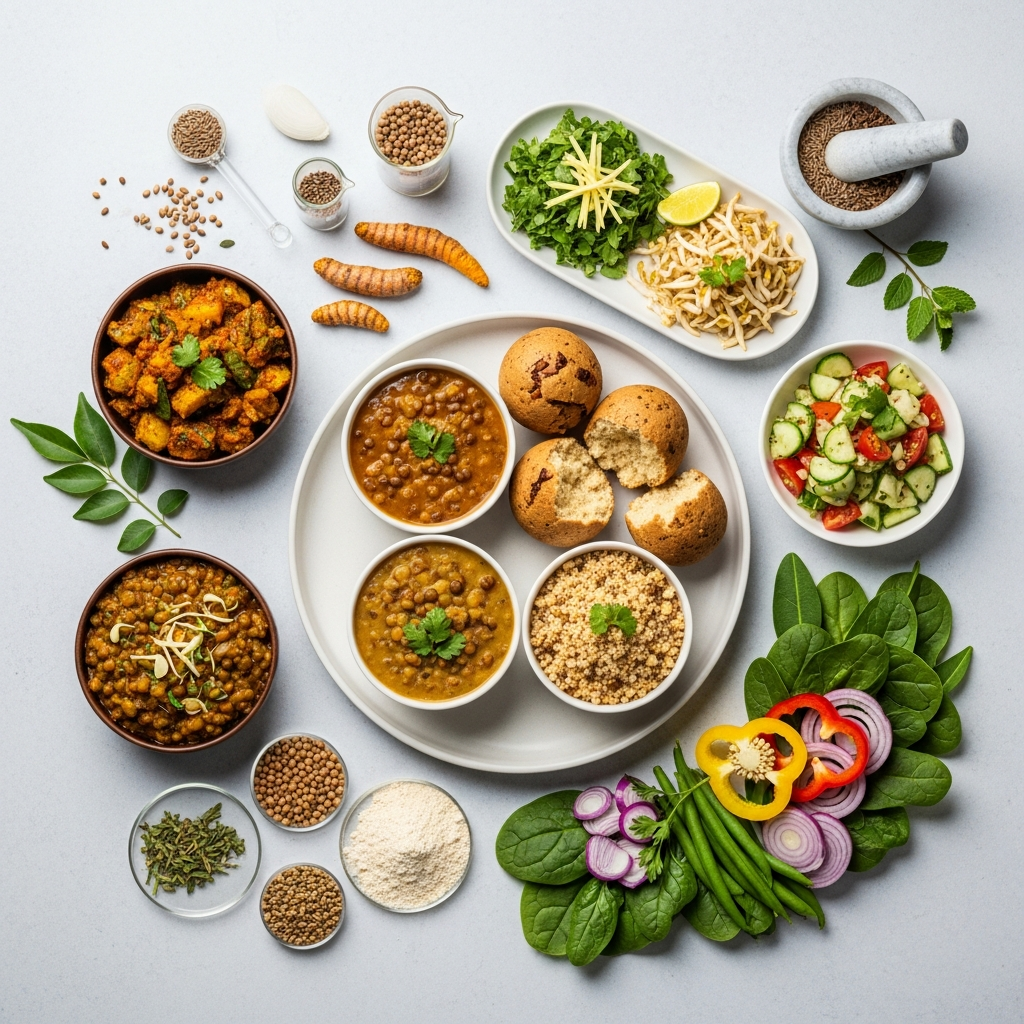
In place of the pungent, foundational flavors of onion and garlic, Jain cooking relies on asafoetida (hing), a resinous gum that provides a similar savory, umami-rich depth when cooked in oil. Ginger, raw banana, and cabbage are often used to replicate the texture and bulk of potatoes and onions. Legumes, lentils (dals), whole grains, and a vast array of gourds, squashes, beans, and leafy greens form the backbone of the diet. Spices like turmeric, cumin, coriander, and chili are used liberally to create vibrant and satisfying dishes.
Nutritionally, a well-planned Jain diet is incredibly wholesome. The emphasis on whole foods, fresh vegetables, and protein-rich lentils and beans, combined with the exclusion of heavily processed items, makes it naturally high in fiber, vitamins, and minerals. It is a testament to the fact that a diet can be ethically uncompromising, nutritionally sound, and gastronomically delightful all at once.
Conclusion
Jain cuisine is far more than a list of dietary restrictions; it is a profound expression of a philosophy dedicated to living in harmony with the world. By extending the principle of non-violence to the smallest and most overlooked forms of life, it challenges us to think more deeply about the consequences of our food choices. The ancient wisdom embedded in its rules—from protecting soil ecosystems by avoiding root vegetables to minimizing harm to microbes by eating fresh—resonates powerfully with modern ecological and scientific understanding. For veggie lovers, herbivores, and anyone interested in conscious eating, the science and soul of Jain cuisine offer a compelling and enlightening path toward a more compassionate plate.